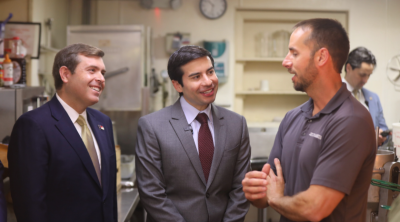
Small businesses are the lifeblood of the American economy. Today, they are driving a powerful revival of Main Street across the country. With more than 36 million small businesses nationwide, making up 99% of all businesses and creating the majority of new jobs, their impact is unmatched.
Under President Trump’s America First agenda, we are building on that momentum by cutting red tape, expanding opportunity, and restoring the conditions for small businesses to hire, invest, and grow with confidence. This National Small Business Week, I want every small business owner in America to hear a clear message from the U.S. Department of Labor: We are working for you. Here’s how:
1. Preparing American workforces for AI
At the Department of Labor, we see artificial intelligence as an immediate opportunity. That is why the U.S. Department of Labor is advancing the Trump Administration’s AI Action Plan to build the most agile, AI-ready workforce in the world. For small businesses, this means a pipeline of workers trained in the skills that matter for the jobs of today and tomorrow.
To accelerate that pipeline, we recently announced approximately $85 million in grant funding to help states and territories expand and modernize Registered Apprenticeship programs, with a performance-based formula that rewards growth in active apprentices and increased employer participation. Registered Apprenticeship is a proven, flexible, debt-free model for building the skilled talent that small businesses need. For a variety of industries, including advanced manufacturing, AI infrastructure, shipbuilding, and healthcare, these programs can help small businesses train workers to their exact specifications while they earn a paycheck.
2. Self-Audits: getting compliance right before problems arise
One of the most valuable things a small business can do is proactively assess its own compliance. Our expanded self-audit initiative makes it easier than ever to do just that by bringing together voluntary tools across multiple agencies, including the relaunched PAID program for resolving wage and leave issues, the Occupational Safety and Health Administration’s no-cost On-Site Consultation Program, correction programs for benefit plan fiduciary and filing issues, and more. Self-audits help small businesses identify and fix potential issues before they become violations, reduce the risk of litigation, and demonstrate good-faith compliance. Visit dol.gov/selfaudit to explore the full set of tools.
3. Offering meaningful compliance assistance
Navigating federal labor law should not require a team of attorneys. Our opinion letter program provides official, written responses from a number of the department’s agencies on how federal labor laws apply to specific workplace scenarios. Whether it’s questions about overtime, independent contractor classification, leave eligibility, workplace safety standards, or benefit plan rules, opinion letters offer authoritative, tailored guidance that small businesses can rely on. Visit dol.gov/opinion-letters to search for existing letters or submit a new request.
4. Making retirement benefits accessible for small employers
Offering retirement benefits helps small businesses compete for talent — but the administrative burden has historically made it difficult. Our guidance on pooled employer plans, issued pursuant to President Trump’s Executive Order on lowering costs for American families, makes it easier than ever for small employers to band together and offer workers access to high-quality, low-cost retirement savings options — without the overhead of sponsoring their own standalone plans. The math is compelling: Lower fees compounded over a career can mean a worker retires with significantly more in savings.
Also, for faith-based organizations, the Department has published tailored guidance to help churches, religious schools, nonprofits, and other faith-based employers select the retirement plan that is right for them, including options not available to secular workplaces. Visit dol.gov/agencies/faith/retirement-plan to learn more.
5. Building a culture of safety with OSHA’s Safety Champions Program
Safe workplaces are productive workplaces. OSHA’s new Safety Champions Program is a free, voluntary, self-guided cooperative program designed to help businesses build or improve an effective safety and health program, step by step. The program follows a three-tier framework — Introductory, Intermediate, and Advanced — and is open to any private or public-sector worksite covered by OSHA. Participants can request guidance from safety and health professionals at no cost, with no penalties and no enforcement implications. Sign up at osha.gov/safety-champions.
The U.S. Department of Labor is proud to stand alongside America’s small businesses during National Small Business Week.
Visit dol.gov to explore the full range of tools and resources available to small businesses.
Keith Sonderling is the Acting Secretary of Labor. Follow him on X, Instagram, and LinkedIn.