


Preface
The Worker Ownership, Readiness, and Knowledge (WORK) provisions of the SECURE 2.0 Act of 2022, directed the Department of Labor (the Department) to establish an Employee Ownership Initiative to promote employee ownership and employee participation. Employee ownership—through worker cooperatives, employee ownership trusts, or employee stock ownership plans (ESOPs)—can enable workers to share in the profits that their labor makes possible and, at its best, foster a more inclusive and engaged workplace.
The purpose of the new initiative is to promote employee ownership. As directed by Congress, the Department will support programs within the States that provide education and outreach to employees and employers on the benefits of these arrangements, as well as technical assistance for creating successful employee ownership models, including information and tools that facilitate financial education and enable employees to share ideas on improving business success.
The statute defines how the Department shall support new and existing programs in the States that foster employee ownership in the ways described above. Specifically, it directs the Secretary to carry out two duties—making federal grants to State programs and acting as a clearinghouse on the techniques employed by such programs—or to fund groups outside the Department of Labor to gather and disseminate such information. While funds were authorized for a grant program and for administrative expenses, Congress has not appropriated any funds for this initiative.
Congress directed the Department to submit a report both on progress related to employee ownership within the United States and an analysis of the costs and benefits of the activities carried out by the Department to promote employee ownership. This report is intended to fulfill this reporting requirement to Congress.
Introduction
Under Sec. 346 0f the SECURE 2.0 Act of 2022, The Worker Ownership, Readiness, and Knowledge (WORK) provisions directed the Department of Labor (the Department) to establish an Employee Ownership Initiative to promote employee ownership and employee participation in the workplace. Employee ownership—through worker cooperatives, employee ownership trusts, or employee stock ownership plans (ESOPs)—can enable workers to share in the profits that their labor makes possible and, at their best, foster a more inclusive and engaged workplace.
Congress directed the Department to support existing and emerging employee ownership programs within the States that focus on:
“(A) providing education and outreach to inform employees and employers about the possibilities and benefits of employee ownership and business ownership succession planning, including providing information about financial education, employee teams, open-book management, and other tools that enable employees to share ideas and information about how their businesses can succeed;
(B) providing technical assistance to assist employee efforts to become business owners, to enable employers and employees to explore and assess the feasibility of transferring full or partial ownership to employees, and to encourage employees and employers to start new employee-owned businesses;
(C) training employees and employers with respect to methods of employee participation in open-book management, work teams, committees, and other approaches for seeking greater employee input; and
(D) training other entities to apply for funding under this subsection, to establish new programs, and to carry out program activities.”(1)
In 2023, the Department launched the initiative with the establishment of a new Division of Employee Ownership (DEO) within the Employee Benefits Security Administration’s (EBSA) Office of Outreach, Education and Assistance. DEO’s primary mandate is to encourage new and existing state programs that promote employee ownership and employee participation.
While still early in its tenure, and with limited staffing, DEO and EBSA leaders cultivated relationships with employee ownership programs in the States and a wide variety of other stakeholders, visited employee-owned businesses, attended and presented at employee ownership conferences, and curated resources to share with employers and employees interested in exploring these arrangements. The Department intends to expand its efforts in future years, including supporting funded grants to states to support their own outreach activities, as permitted by appropriations.
Section 1: What is Employee Ownership?
Employee ownership, also known as worker ownership, describes various ways that a large segment of a company’s workforce can gain financial stakes in the business. Employee ownership is intended for the general workforce, and all employees who meet basic criteria in the governing documents are eligible to be owners. The concept of employee ownership speaks to who participates as owners but not to how much of a company is owned by those employees.
Models include employee stock ownership plans (ESOPs), worker cooperatives, and employee ownership trusts.
An employee stock ownership plan, or ESOP, is a federally regulated retirement benefit plan that can own part or all of a company. The plan takes the form of a trust that holds company shares on behalf of participants and beneficiaries. Participants include current employees, vested employees who have left the company but not retired, and retirees.
A worker cooperative is a business owned and controlled by the people who work at the business. Employee-owners purchase a membership share, which entitles them to profit sharing and participation in governance.
An employee ownership trust is a form of perpetual purpose trust that can own all or part of a business. The trust holds shares on behalf of employees and ensures that the company prioritizes employee benefit as part of its core purpose.
The Department is aware of other types of equity compensation and business ownership that can be structured to include employees at all levels, such as stock options, stock grants, and LLC membership, but these are not currently included in DEO’s educational efforts.
The Department’s Employee Ownership Initiative focuses on encouraging employee ownership through models that are always open to all workers, not just senior leaders.
There is no single definition of what makes a company “employee-owned,” but Congress provides specific tax benefits for companies that are at least 30% owned by their employees. In other words, companies can have an employee ownership plan, such as an ESOP, but not be “employee-owned” per se, if non-employee shareholders own most of the company.
Section 2: Employee Ownership in the United States
Origins
The early history of the United States includes elements of employee ownership. Benjamin Franklin expanded the print industry by establishing print shops in various American cities to be run by journeymen, who could eventually take over the shop themselves after several years of partnership. Franklin also established the Philadelphia Contributionship, a mutual insurance company which is recognized as the longest operating cooperative in the United States. Moreover, following the American Revolution, Treasury Secretary Alexander Hamilton, with the support of George Washington and Thomas Jefferson, successfully encouraged the Federal government to create tax breaks to restore the cod fishing industry, which was decimated during the American Revolution. However, the assistance was only available to businesses if their employees received a share of the profits.
During the Industrial Revolution, Charles Pillsbury, Andrew Carnegie, and John D. Rockefeller instituted profit-sharing programs in their companies. The first worker cooperatives in the U.S. were formed as small businesses in the 1850s, a century before the first ESOPs. In the first half of the 20th century, many household name companies such as Sears, Roebuck and Co. and Procter & Gamble shared profits and facilitated company stock ownership for their employees.
In 1956, Louis Kelso developed a new concept that he tried out on a number of businesses with considerable success: the employee stock ownership plan (ESOP). Kelso’s ESOP concept was a trust that borrowed money to buy employer stock and repaid the loan from future company profits, allocating shares to employees over time to broaden capital ownership. This approach was formalized under the Employee Retirement Income Security Act of 1974 (ERISA).
Present day
Employee ownership is present in every state in the country, with ESOPs being the most widespread form. Worker cooperatives and employee ownership trusts, though few, are forming at faster rates.
Employee stock ownership plans (ESOPs)
As qualified retirement plans, ESOPs are required to submit annual Form 5500 filings with the Department of Labor. The Form 5500 collects data on the benefits, funding, investments, and operations of employee benefit plans. The Department publishes 5500 raw datasets, refined private pension research files, and annual summary statistics of ESOPs including the number of ESOPs, participants, and assets broken out by leveraged status and whether the ESOP is stand-alone or KSOP.(2) Stand-alone ESOPs’ primary function is to hold employer stock on behalf of employees, whereas KSOPs combine this ESOP feature with a 401(k) plan component. In a KSOP, like in a traditional 401(k), participants can contribute their own money and also receive employer contributions of stock or cash. In ESOPs, participants earn company shares as part of their compensation. Typically, participants cannot contribute to stand-alone ESOPs.
Overview of current ESOP plans: Over the past half century, the number of ESOPs grew from a few hundred in 1975 to 6,525 plans in 2023.(3) Based on data from Form 5500 filings for plan years ending in 2023 (the latest available), these plans cover more than 15 million participants and hold estimated assets of $2.0 trillion (including employer securities and other retirement plan assets). Large ESOPs (those with 100 or more participants) made $160.6 billion in direct benefit payments in 2023.
Most ESOPs are stand-alone ESOPs, but most ESOP participants and assets are in KSOPs. While they comprise only 15% of ESOPs, KSOPs tend to be larger plans, often in public corporations, and they cover 87% of ESOP participants and 88% of ESOP assets.
About half of ESOP plans are small plans with fewer than 100 participants.
74% of stand-alone ESOPs are sponsored by companies that also sponsor additional retirement plans for their employees, mostly defined contribution plans such as 401(k)s. When considering all ESOPs, this number drops to 67% because KSOPs already have a 401(k) feature.
ESOPs can be found in any industry, but there are some notable industry concentrations: approximately 29% of ESOPs are in service sectors, 20% in manufacturing, 16% in construction, and 13% in finance, insurance, and real estate combined.(4)
Recent ESOP trends: As shown in the charts below, the total number of ESOP plans stayed relatively steady over the past ten years, although the portion of ESOPs that are leveraged vs. nonleveraged flipped. The majority of ESOP plans (53%) now fall into the category of leveraged stand-alone ESOPs, as compared to 41% a decade ago.
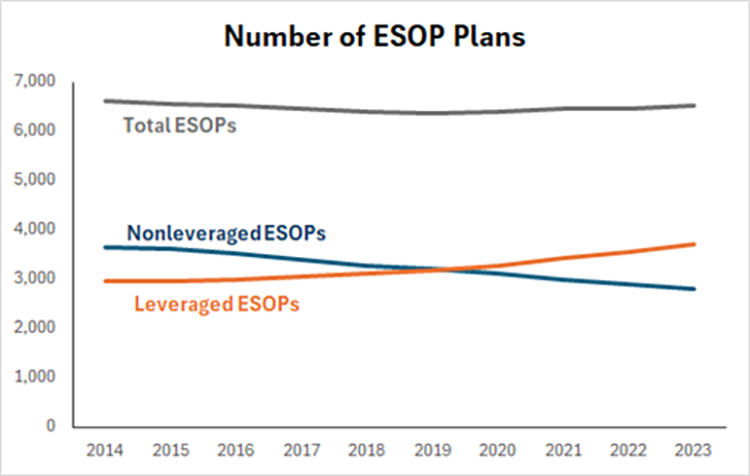
Source: Department of Labor, EBSA. Private Pension Plan Bulletins: Abstracts of 2014-2023 Form 5500 Annual Reports. Tables D10.

Source: Department of Labor, EBSA. Private Pension Plan Bulletins: Abstracts of 2014 and 2023 Form 5500 Annual Reports. Tables D10.
The number of total ESOP participants grew by 8% from 14.0 million in 2014 to 15.1 million in 2023. The growth was driven by nonleveraged KSOPs, which added 1.2 million participants, and leveraged stand-alone ESOPs, which added 277,000 participants. There were fewer participants in leveraged KSOPs and nonleveraged stand-alone ESOPS in 2023 than in 2014.(5)

Source: Department of Labor, EBSA. Private Pension Plan Bulletins: Abstracts of 2014 and 2023 Form 5500 Annual Reports. Tables D10.
The total assets in ESOP plans have grown at a notably faster pace than the number of plans and participants, increasing by 57% over this ten-year period. Average assets per plan grew from $197 million in 2014 to $314 million in 2023.
Over the last ten years, leveraged stand-alone ESOPs experienced the largest growth in plans, participants, and assets. From 2014 to 2023, plans of this type increased by 28%, while their total participants grew by nearly 40% and total assets by 184%. This type of ESOP paid $6.2 billion in direct benefits in 2023, nearly tripling from 2014.
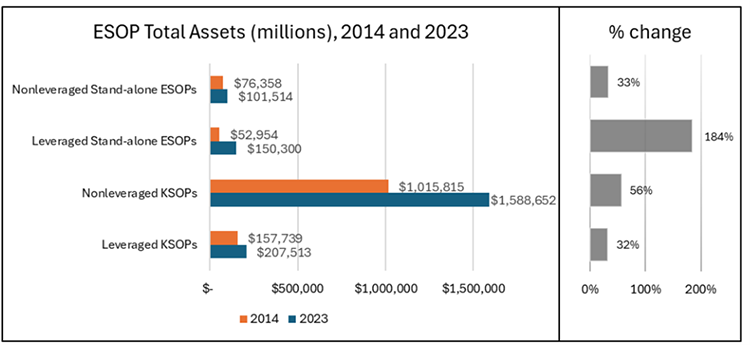
Source: Department of Labor, EBSA. Private Pension Plan Bulletins: Abstracts of 2014 and 2023 Form 5500 Annual Reports. Tables D10
Worker cooperatives
Worker cooperatives are not tracked by any single government source, although some are registered with their secretaries of state, if statutes exist, as cooperative or worker cooperative corporations (they can also use other corporate structures or limited liability companies). The 2025 report on a biennial survey conducted by the national trade association for worker cooperatives and its nonprofit partner identified 820 known worker cooperatives and democratic workplaces nationwide.(6) The authors estimate that these firms employ 13,520 people and have a total combined revenue of $806 million.
According to the biennial surveys, the number of known worker cooperatives more than doubled from 323 in 2014 to 820 in 2024 (since the census is biennial, this is not the same timeframe as that used above for ESOPs). This increase is driven in part by the move to transition mature businesses to worker cooperatives, as well as by organized efforts to support startup worker cooperatives through rural cooperative development centers (many funded in part by grants from the USDA), nonprofits, and some local governments, most notably New York City. Almost 30% of these worker cooperatives were formed by transitioning an existing business, usually owned by one or more founders, to cooperative ownership. There are now 3.5 times more worker co-ops formed through transition than there were in 2014.(7)
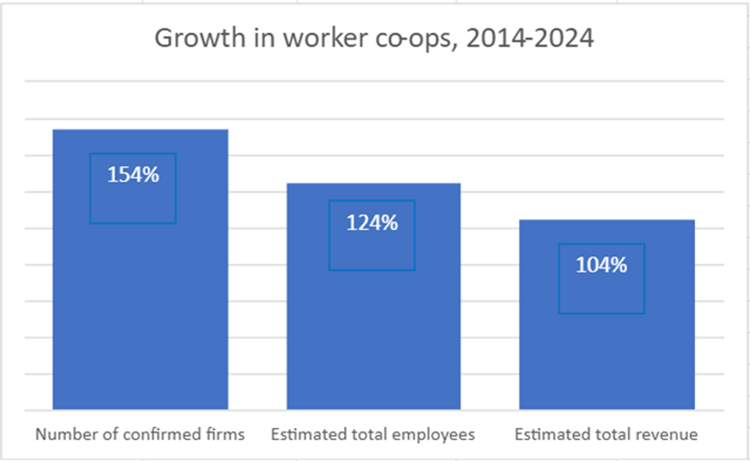
Source: U.S. Federation of Worker Cooperatives and Democracy at Work Institute. Worker Cooperatives in the US: 2015 State of the Sector and 2025 State of the Sector of Worker Cooperatives and Democratic Workplaces
Worker cooperatives exist in many industries. The highest numbers of worker cooperatives operate today in food service, business support services, agricultural production, cleaning services, and engineering and manufacturing. The largest worker cooperatives, with thousands of employees, are in-home health care and ride sharing. The median worker cooperative, however, is a microbusiness with fewer than ten employees.
Employee ownership trusts (EOTs)
EOTs are new to the United States, with the first known EOT formed in 2014. They are forming at increasing rates, partially driven by the growing adoption of this model in the U.K., where there are more than 2000 EOTs, and the wider use of trust ownership across Europe. Like worker cooperatives, EOTs are not tracked by a single government source, and only a handful of states have legislation specifically guiding trusts of this nature. Data used for this report is from a nonprofit organization that is monitoring the formation of and providing education about EOTs, perpetual purpose trusts (PPTs), and similar models of ownership.
Between 2014 and 2023, nine EOTs were formed in the first five of those ten years, and 21 in the second five. In 2024 and 2025, at least twelve new EOTs formed. Current estimates are that 32 employer businesses are substantially owned by employee ownership trusts, while at least four more are owned by PPTs that have employees as one of the stakeholders explicitly named in their trust document’s statement of purpose. The majority of EOTs in the database were formed to purchase longstanding businesses, many of them dating back to the 1970s, 80s, or 90s and one to 1877.
Among this small sample of existing EOTs and employee-focused PPTs, there appear to be no strong industry concentrations. There are, however, multiple EOTs in the following industries: food and agriculture, manufacturing, software, and consulting. The largest EOT was formed in 2025 when it took more than 30% ownership of a home health care company with tens of thousands of employees. The next largest ones include two in food and agriculture (one with 500-1000 employees, another with 200-500) and two with between 200 and 500 employees in architecture and construction and scientific research.(8)
Trends in employee ownership
Over the last ten years, the employee ownership landscape was impacted by the aging demographics of our nation and by the involvement of a wide range of stakeholders.
More employee-owners and more leveraged buyouts
As described above, there was growth across all forms of employee ownership in the past decade: 8% more total ESOP participants (in roughly the same number of plans), more than twice the workforce in worker cooperatives, and tens of thousands of employees in EOTs, where previously there were none.
Looking more closely at the changes in recent years, there appears to be an increase in the use of employee ownership as an exit and liquidity strategy for owners of privately held businesses. The 28% increase in leveraged stand-alone ESOPs, for example, may be driven in part by business owner retirements, though other factors such as re-leveraging to manage repurchase obligations may also be at play. It is more common for worker cooperatives to be formed through transition as well (29% in 2024 vs. 21% in 2014); this is almost always achieved through leveraged buyouts because employees do not have the cash to purchase the business. In addition, the vast majority of EOTs are set up to buy longstanding businesses, in whole or in part, from the current owners.(9)
Employee ownership advocates cite the so-called silver tsunami as a reason to encourage business owners who are nearing retirement to consider employee ownership.(10) The silver tsunami, or retirement wave among baby boomers, has now reached its height with “Peak 65,” a four-year period during which more than 11 million baby boomers are turning 65 every day.(11) With many of these baby boomers owning successful businesses, this demographic phenomenon creates an opportunity to transition longstanding private companies to employee ownership, thus preserving both businesses and jobs. Not all owners who sell their business to employees are of retirement age, however, and many sellers stay on with the business for some time. More study is needed to understand the drivers and motivations that cause business owners to decide to sell their companies to their employees.
Diverse stakeholders
The prospect of losing jobs and local businesses helped to elevate the profile of employee ownership in the public sector. There was a slow but steady increase in the number of state and local governments directly supporting employee ownership. Five of the nine state employee ownership programs in existence today, for example, were started in the 2020s. Half of states now have a statewide nonprofit promoting employee ownership,(12) and many national, regional, and local nonprofits provide technical assistance, training, and education. In academia, a consortium of more than a dozen universities came together in 2024 to advance the study and practice of employee share ownership.(13)
In the private sector, there is a fairly well-developed ecosystem of professional service providers with expertise in employee ownership, especially ESOPs and, more recently, EOTs (worker co-op service providers are often nonprofit organizations or independent consultants).
The Department also observed a variety of financial strategies and corporate models being used to further employee ownership. For example:
An initiative among private equity firms is giving shares to non-managerial employees in some of their portfolio companies so that employees can benefit financially when the company is sold. A nonprofit organization reports that participating firms paid out more than a billion dollars to about 41,000 employees “outside the C-Suite" who participated in liquidity events.(14) Their approach is different from ESOPs and the other forms of employee ownership discussed here in a number of ways, including that it is not designed for employees to be long-term shareholders.
There are now employee-owned holding companies using both ESOP and cooperative structures, and several small private equity and M&A firms focused exclusively on acquiring companies to make them employee-owned.
Diverse types of financial institutions and funds are financing employee ownership transitions and employee-owned companies. This includes banks that have ESOP lending practices, Community Development Financial Institutions and small loan funds that finance cooperatives and small employee ownership deals, and a small community of equity investors. Still, many employee ownership buyouts are financed with seller notes, either exclusively or in combination with external lenders.
Multiple types of employee ownership
Both the Main Street Employee Ownership Act of 2018 and the WORK provisions of SECURE 2.0 promote employee ownership generally, in the first case naming both ESOPs and worker cooperatives as a focus of the bill, and in the second case not naming any specific type of employee ownership. This aligns with the field of employee ownership, as advocates and educators are increasingly referencing employee ownership as an umbrella term encompassing various models. Examples of this include the state employee ownership programs described in this report and the network of nonprofit statewide centers.
This approach serves the interests of a wide range of employers and employees. Each type of employee ownership has unique features making it better suited to some situations than others. For example, the cost and complexity of establishing and administering an ESOP make this model impractical for many businesses. One guideline that ESOP advisors frequently use states that most businesses with fewer than 20 employees will not have the cash flow and other conditions to support an ESOP. According to the U.S. Small Business Administration, 90% of small businesses with employees fall into this category.(15)
Section 3: How states are promoting employee ownership
Supporting state programs that promote employee ownership is the core purpose of the Employee Ownership Initiative. Although no funds were appropriated to provide direct support in the form of grants, DEO developed relationships with existing programs and documented their structure and activities. To distinguish them from other statewide organizations that support employee ownership, EBSA created the term “state employee ownership programs” (SEOPs).
SEOPs are state-funded initiatives that promote employee ownership. They are typically run by state agencies, universities, or nonprofits. SEOPs aim to educate the public and support businesses transitioning to employee ownership. Some offer grants or tax credits to facilitate that transition.
Existing state employee ownership programs (SEOPs)
As of December 2025, nine states have state-funded employee ownership initiatives. These fall into three categories, with some states included in more than one:
State agency programs: California, Colorado, Massachusetts, Michigan, and Washington house employee ownership efforts within state agencies.
Centers at public universities: Iowa, New Jersey, and Ohio host employee ownership centers at their public universities.
Nonprofits with state funding: California, Colorado, Michigan, New Jersey, and Vermont fund employee ownership education and technical assistance through grants or contracts.
Since 2019, these states and at least fifteen others passed or considered employee ownership legislation. These developments reflect growing interest in employee ownership across the country. In addition, about half of states have a nonprofit center for employee ownership.(16) Most of these do not receive state funding, so they are not included here as SEOPs.
There are three common strategies that states are using to encourage employee ownership:
Creating permanent employee ownership programs within state agencies, often in small business or economic development offices.
Funding nonprofits or university-based centers to run education campaigns and provide technical assistance to businesses.
Offering financial assistance to businesses transitioning to employee ownership through tax credits, grants, or reimbursements for professional services. This often begins with feasibility studies, which identify what’s needed for a successful transition.
The chart below summarizes the history, activities, and other details of the nine state employee ownership programs that exist as of December 2025.
| Program Name | Description |
|---|---|
| California Employee Ownership Hub | In 2022, legislation created an Employee Ownership Hub within the California Office of the Small Business Advocate. The office developed an employee ownership webpage and provided a grant to the nonprofit Project Equity to provide technical assistance related to employee ownership. It has not received funding for dedicated staff or programs. |
| Colorado Employee Ownership Office | In 2019, Colorado’s governor created the Colorado Employee Ownership Commission by executive order. The commission’s work paved the way for legislation that established employee ownership tax credits and a permanent employee ownership office in the state’s Office of Economic Development and International Trade. Over time, the state has expanded both the size and the eligible uses of the tax credits. |
| Iowa Center for Employee Ownership | The University of Northern Iowa established the Iowa Center for Employee Ownership in 2023. The center conducts outreach statewide, hosts an annual employee ownership conference, and is working with the university to engage researchers and students. It also provides technical assistance to small and rural businesses to help them transition to employee ownership and guides larger firms through consultations and facilitations. |
| Massachusetts Center for Employee Ownership | In 2022, the Economic Development bill established the Massachusetts Center for Employee Ownership, an office within the Massachusetts Office of Business Development, and created a 19-member advisory board. Going back to 1989, the state had intermittently funded external partners to deliver employee ownership programs, but this new phase makes the effort permanent. |
| Michigan Employee Ownership Pilot Program | In July 2025, Michigan’s Department of Labor and Economic Opportunity announced a $500,000 pilot program to support employee ownership. Eighty percent of funds are designated for technical assistance to businesses exploring or transitioning to employee ownership. The rest is a grant to the nonprofit Michigan Center for Employee Ownership for outreach and program administration. |
| New Jersey ESOP Assistance Program | The New Jersey Economic Development Authority launched a $2.7 million ESOP Assistance Program in 2024. The Rutgers University-based New Jersey/New York Center for Employee Ownership, which was established in 2017, provides outreach and education on all forms of employee ownership. New Jersey has also contracted with two firms to conduct ESOP feasibility studies for qualifying businesses. |
| Ohio Employee Ownership Center | Founded in 1987, the Ohio Employee Ownership Center at Kent State University received state grants for many years, along with infrastructure support from the university. Today, with income from programs and philanthropy, the center conducts outreach and research; provides technical assistance to prospective employee-owned companies; and delivers programs including conferences and events, leadership roundtables, retreats for employee-owners, and training for ESOP fiduciaries. |
| Vermont Employee Ownership Center | The Vermont Employee Ownership Center (VEOC) started in 2001 with support from local employee-owned businesses, and it has received funding from the state since the mid-2000s. It hosts an annual conference and provides technical assistance to businesses exploring or transitioning to employee ownership. VEOC currently gets about one third of its funding from the state’s Agency of Commerce and Community Development. |
| Washington Employee Ownership Program | In 2023, Washington passed a law to create a program within its Department of Commerce to support employee ownership and a commission to guide it. A tax credit helped businesses cover transition costs. While the tax credit and program funding were cut during a 2025 budget crisis, the program remains in statute and may be revived in the future. |
State incentives and subsidies for employee ownership
From initial feasibility studies to training new employee-owners, employee ownership transitions can be expensive. To ease this burden, some states created financial support programs through tax credits, grants, and cost reimbursements. The chart below highlights how these states are helping businesses offset transition costs at different stages.
| State programs that offset costs | Key features |
|---|---|
| Colorado provides two employee ownership tax credits. The “Establish or Expand” credit covers costs of implementing employee ownership for the first time or expanding the percent of a company that is employee-owned. Amounts: up to $150,000 for new ESOPs, $40,000 for new co-ops or EOTs, and $25,000 for new “alternative equity structures.” The “Strengthen and Thrive” credit gives up to $50,000 to support activities that are essential to the success and sustainability of employee ownership in the first seven years after the transition. |
|
| Iowa offers up to $25,000 in reimbursement to businesses for the cost of completing an ESOP feasibility study. |
|
| Michigan’s pilot program provides grants to help businesses assess whether employee ownership is a good fit. Grant amounts are flexible and evaluated on a case-by-case basis. |
|
| New Jersey’s ESOP Assistance Program provides up to $35,000 for professional services related to ESOP feasibility assessment. |
|
Section 4: The Department Employee Ownership Initiative
Creation of the Division of Employee Ownership
Following the passage of SECURE 2.0 in December 2022, the Department of Labor’s Employee Benefits Security Administration (EBSA) took responsibility for implementing the WORK provisions, including establishing an Employee Ownership Initiative. In June 2023, EBSA received approval from the Department’s Chief Human Capital Officer to establish DEO within EBSA’s Office of Outreach, Education and Assistance (OEA) and hire a Chief to lead the division.
OEA has a unique mission to provide participant education, informal dispute resolution, and compliance assistance. Its expertise in education and communications and its partnerships with EBSA’s regional offices make it an appropriate home for the DEO. OEA is entirely distinct from the regulatory and enforcement offices within EBSA, so there is no conflict of interest between EBSA’s enforcement responsibilities for ESOPs and DEO’s mission to promote employee ownership.
The WORK Act authorized funding for a $50 million grant program to support employee ownership programs within the states, as well as funding for administration of the grant program and development of the Employee Ownership Initiative. Congress, however, has made no appropriation for these purposes. As such, EBSA is using funds from its budget to cover the full-time Chief’s role. This is especially notable in the context of EBSA’s overall funding and responsibilities.
Along with the approval to hire a DEO Chief, OEA submitted an updated organizational chart, which envisioned four additional staff members working on employee ownership. While EBSA funded the Chief’s role from its existing budget, without appropriations, it cannot activate additional positions.
OEA led a competitive hiring process for the Division Chief, which led to Hilary Abell, a national leader in the employee ownership field, starting the role on June 30, 2024. During the interim period, senior staff within OEA shared the initial functions of the DEO, with a focus on meeting with stakeholders, learning about the diverse forms of employee ownership, scoping the hiring strategy and responsibilities of the Chief’s role, and managing the hiring process.
Initial activities
Upon arrival in mid-2024 the DEO Chief divided her work in four categories: outreach, education, and stakeholder relations; support for SEOPs; early-stage technical assistance for employers and employees on questions related to employee ownership; and development of an online clearinghouse of information on employee ownership and participation. Initial activities in each area are described below.
Outreach, education, and stakeholder relations
DEO and leaders of both EBSA and the Department participated in numerous events and met with a wide variety of stakeholders to advance the Employee Ownership Initiative.
Activities included the following:
Secretary Chavez-DeRemer gave a keynote presentation at the ESOP Association’s annual conference in May 2025.
Senior EBSA leaders visited several employee-owned companies and spoke at employee ownership events.
A former Assistant Secretary visited employee-owned companies in Connecticut, Georgia, Ohio, and Missouri and spoke at several gatherings of the ESOP, worker cooperative, and broader employee ownership communities. She also joined a panel of federal government leaders at the White House Convening on Employee Ownership in July 2024.
A former Principal Deputy Assistant Secretary presented at an employee ownership summit and visited cooperatives and an employee ownership trust in California.
Over her 18-month tenure, the DEO Chief
Held approximately 100 meetings and listening sessions with a diverse array of stakeholders. These stakeholders represent approximately eighty distinct organizations that can be categorized as follows:
35% nonprofit organizations that provide education and technical assistance related to employee ownership or cooperatives
15% employee-owned companies or trade associations for ESOPs or worker cooperatives
12% private sector service providers serving employee-owned businesses
10% offices within the Department of Labor, USDA, or SBA
9% state government agencies
6% other nonprofits interested in employee ownership
4–5% each, universities, local government, and labor unions
Made presentations at conferences or events including
Three conferences convening stakeholders in the employee ownership field
A meeting of the Inter-Agency Working Group on Cooperative Development
A webinar sponsored by a state labor and economic development agency
Two meetings of state employee ownership commissions
Attended several additional conferences of employee ownership stakeholders for relationship building and learning purposes
Authored or partnered with authors to publish several articles(17) and blogs about employee ownership
Support for state employee ownership programs (SEOPs)
DEO is faithfully following its mandate to “encourage new and existing programs within the states” that seek to expand employee ownership in their own jurisdictions. This effort includes:
Cataloging and profiling the nine existing SEOPs
Holding listening sessions to learn about SEOPs' goals and challenges and solicit their ideas for how the Division can support their efforts
Providing guidance and thought partnership upon request
Organizing peer learning meetings—one held in June 2025 and another planned for early 2026.
Existing SEOPs have similar goals but different needs, depending on their level of experience, funding, and institutional context. Some are decades old, while others are just getting started. Most expressed interest in support or learning in the following areas:
Outreach strategies: ranging from familiarizing business owners and other stakeholders with the concept of employee ownership to getting the word out about available resources and incentives for employee ownership
Materials: ranging from storytelling videos to easy-to-understand technical information on regulations, laws, tax incentives or government programs related to employee ownership.
Sustaining their programs’ operations, whether through state or private funding.
Support for employers and employees
DEO is committed to being a resource for employers and employees around the country by providing direct guidance where relevant and offering education and ideas for where to find further support and in-depth technical assistance. A dedicated email address, ownership@dol.gov, is available to all, as publicized on EBSA’s website, and DEO responds quickly to all inquiries. DEO received only a small number of inquiries thus far but hopes this will change with more outreach efforts and as the expanded webpage gets increasing traction. Employers and employees that DEO supported include:
Seven business owners, inquiring about different types of employee ownership. They include: a small business owner in Florida who wanted to restart a once successful consumer products business as a cooperative, an electrical contractor in West Virginia who wanted to transition his twenty-year-old company to an employee ownership trust, and a forty-year-old trucking company in New Mexico interested in an ESOP. Others, from Florida, Washington, Colorado, and Missouri inquired about financing for employee ownership transitions and other topics. In each case, DEO answered their questions and suggested resources and next steps.
A participant in a newly established ESOP who had not received concrete information from the sponsor and was confused about what to expect.
Launch of Employee Ownership Initiative website
Initial website. EBSA launched an initial website for the Employee Ownership Initiative in January 2025. It included the following:
Basic definitions of the primary types of employee ownership
A one-minute animated video describing the general concept of employee ownership /worker ownership, its potential benefits, and an invitation for employers and employees alike to contact DEO to learn more
A brief description of DEO
Status of grant funding, currently “If Congress provides appropriations so that funds become available, details about the grant program will be posted on this website.”
A set of links to government and university websites where the public can learn more about employee ownership, including the following:
Federal agency resources at the United States Departments of Agriculture, Commerce, and Treasury, as well as the Small Business Administration
Nine employee ownership programs supported by states and two by local governments
Five public universities that have institutes or centers dedicated to employee ownership
Expanded website. In January 2026, the Division of Employee Ownership expanded the Employee Ownership Initiative website to include information on all the topic areas outlined in its statutory mandate. This expanded website aims to achieve three related yet distinct goals:
Provide objective information in plain language about various types of employee ownership to help business owners and employers learn about these options, and about succession planning that may include, but not be limited to, these options. This same information can also help states and other stakeholders in their own outreach efforts and help to educate employee-owners.
Provide clear yet detailed information about SEOPs to new and existing state programs, and as a resource for all states and interested stakeholders.
Provide objective information in plain language about some of the ways that employees can be more involved in the companies where they work, and how these approaches can support the success of employee ownership and the businesses where it is implemented.
The expanded website now includes:
Information on each of the types of employee ownership that are, by definition, designed to be available to all employees who meet basic criteria outlined in the governing documents: ESOPs, worker cooperatives, and employee ownership trusts.
Brief profiles of each of the nine existing SEOPs and the strategies they are using to expand employee ownership in their states. This resource is intended to make information easily accessible to the 41 states that have no state-sponsored programming on employee ownership.
A brief history of federal and state government support for employee ownership.
Short articles on key topics that address success factors for employee ownership: employee participation and ownership culture, open-book management, and business succession planning.
To EBSA’s knowledge, this is the first time that a federal agency has made this kind of information available.
Assessment of program to-date
EBSA established the Employee Ownership Initiative and built a solid foundation for future programs in less than two years, working with a single staff person and without any appropriations. DEO built relationships with a wide range of federal, state, industry, and community stakeholders; spoke at events and generated articles and blogs; advised state partners and employers; and created a website to educate the public about employee ownership, employee participation, and related state programs. The minimal program costs thus far include a small amount of travel and one full-time equivalent.
If/when Congress appropriates funds, DEO will support a grant program for state employee ownership programs. If implemented over five years as envisioned in the WORK Act, such a program would facilitate important insights about how states can effectively foster employee ownership and participation.
Potential future work
Subject to available resources, EBSA aims to:
Support a grant program for employee ownership programs in the states in collaboration with the Department’s primary grant-making agency, the Employment and Training Administration.
Increase support of SEOPs and help them measure the effectiveness of their activities, learn from each other, and increase their impact over time.
Expand the educational content of the clearinghouse, including multimedia components.
Expand information and educational programs related to employee-owner engagement, participation, and financial wellbeing.
Pursue strategies to increase the reach of online resources and quantify page traffic and resource utilization.
Collaborate with national partners on outreach and education campaigns to reach business owners.
Partner actively with other federal agencies both within and outside the Department, such as the SBA, which Congress directed in 2018 to create a program to promote employee ownership and cooperatives.
Build out DEO as a small team with a modest budget for travel, communications and marketing, and education, to create a sustainable and impactful initiative.
Conclusion
The WORK provisions of the SECURE 2.0 Act of 2022 directed the Department to establish an Employee Ownership Initiative to promote employee ownership and employee participation in the workplace and subsequently report to Congress on the benefits and costs of doing so.
This report summarizes the efforts taken by the Department, and specifically EBSA’s DEO since its creation in 2023, towards this goal. Despite its brief tenure and funding and staffing limitations, DEO established relationships with a wide range of stakeholders, including all the SEOPs, conducted outreach efforts, and provided online resources for employees, employers, and state leaders interested in exploring these arrangements.
DEO hopes to expand its efforts in the coming years. Future projects include providing training and technical assistance, as well as promoting best practices to states seeking to support employee ownership. As such, this report to Congress serves as a baseline to measure future improvements in outreach and promotion of employee ownership to increase workers’ financial security and enhance their participation in the workplace.
Footnotes
P.L. 117-328, § 346 (Dec. 29, 2022) ↩
Available at: https://www.dol.gov/agencies/ebsa/about-ebsa/our-activities/public-disclosure/foia/form-5500-datasets, https://www.dol.gov/agencies/ebsa/researchers/data/private-pension-plan-data, https://www.dol.gov/agencies/ebsa/researchers/statistics/retirement-bulletins/private-pension-plan. ↩
National Center for Employee Ownership, “50 Years of Data: The ESOP Universe in 1974,” https://www.nceo.org/member/newsletter/50-years-of-data-the-esop-universe-in-1974. U.S. Department of Labor, EBSA. (September 2025) Private Pension Plan Bulletin: Abstract of 2023 Form 5500 Annual Reports, Table D10. https://www.dol.gov/sites/dolgov/files/ebsa/researchers/statistics/retirement-bulletins/private-pension-plan-bulletins-abstract-2023.pdf. ↩
Based on EBSA calculations using Form 5500 filings for plan years ending in 2023. ↩
U.S. Department of Labor, EBSA. (September 2016) Private Pension Plan Bulletin: Abstract of 2014 Form 5500 Annual Reports, Tables D10, D11. https://www.dol.gov/sites/dolgov/files/ebsa/researchers/statistics/retirement-bulletins/private-pension-plan-bulletins-abstract-2014.pdf. U.S. Department of Labor, EBSA. (September 2025) Private Pension Plan Bulletin: Abstract of 2023 Form 5500 Annual Reports. https://www.dol.gov/sites/dolgov/files/ebsa/researchers/statistics/retirement-bulletins/private-pension-plan-bulletins-abstract-2023.pdf. ↩
U.S. Federation of Worker Cooperatives and Democracy at Work Institute. 2025 State of the Sector of Worker Cooperatives and Democratic Workplaces (forthcoming). The estimates in this State of the Sector reports and prior ones are not comparable to Form 5500 ESOP data. Rather the State of the Sector report estimates are based on voluntary survey responses from a convenience sample and outreach and research conducted by the Worker Cooperative Enterprise Census. Worker Cooperative Enterprise Census FAQs: https://docs.google.com/document/d/1juGqFIs8dCNvC8flqCZcEsiRzG4cgWhFFXJPHc0A1y8/edit?usp=sharing ↩
U.S. Federation of Worker Cooperatives and Democracy at Work Institute (2015). Worker Cooperatives in the US: 2015 State of the Sector. U.S. Federation of Worker Cooperatives and Democracy at Work Institute (2025). 2025 State of the Sector of Worker Cooperatives and Democratic Workplaces. ↩
Broughton, Anne-Claire; Blasi, Joseph; Schlag, Zoe; Razo, Derek; Hand, Mark, 2022, "Employee Ownership Trusts and Perpetual Purpose Trusts in the United States", Harvard Dataverse, V7; https://doi.org/10.7910/DVN/EYGHCW UNF:6:957O2N5OyYuGM3Rb6t8uaw== . The database is based on research and voluntary reporting and is not comparable to Form 5500 ESOP data. ↩
See, for example, Project Equity. (2025). The Silver Tsunami of retiring business owners. https://project-equity.org/impact/silver-tsunami/ ↩
Shapiro, S and Stuttgen, L. (April 2024). The Peak Boomers Impact Study. https://www.protectedincome.org/wp-content/uploads/2024/04/Peak-Boomers-Econ-Impact-Study-ALI-RII-Shapiro-Stuttgen-EMBARGOED-Apr-18-2024-041924.pdf ↩
Employee Ownership Expansion Network. (2025). Expanding Employee Ownership Across the U.S. https://www.eoxnetwork.org/statecenters ↩
Rutgers-New Brunswick School of Management and Labor Relations. (2024). Overview of the University Consortium on Employee Share Ownership. https://smlr.rutgers.edu/faculty-research-engagement/institute-study-employee-ownership-and-profit-sharing/university ↩
Ownership Works. (2025). 2025 Impact Report, page 3. Ownership-Works-2025-Impact-Report.pdf. In reference to the datapoint cited, the authors note that “Given the variability in equity value and workforce headcounts over time, projected average wealth per employee should not be inferred.” ↩
U.S. Small Business Administration Office of Advocacy. (2024). 2024 Small Business Profile. https://advocacy.sba.gov/wp-content/uploads/2024/11/United_States.pdf ↩
See footnote 12. ↩
See Kenney, A. (April 1, 2025). What to know when your client is considering employee ownership. Journal of Accountancy. https://www.journalofaccountancy.com/issues/2025/apr/what-to-know-when-your-client-is-considering-employee-ownership/ ↩