


RETAIN was the nation’s first federally funded initiative to test early-intervention strategies that help workers stay at work or return to work (SAW/RTW) after a work-limiting injury or illness. The initiative was led by the U.S. Department of Labor’s (DOL) Office of Disability Employment Policy, in partnership with the Employment and Training Administration, DOL’s Chief Evaluation Office, and the Social Security Administration (SSA).
Together, these agencies developed RETAIN to improve coordination between health care and employment services to help workers return to productive work as quickly and safely as possible—either in their previous job or, when necessary, in a new role. The primary goals of RETAIN were to:
Increase employment retention and labor force participation among individuals who acquire, or are at risk of developing, a disability that limits their ability to work.
Reduce long-term work disability among program participants, including reduced entry into Social Security Disability Insurance (SSDI) and Supplemental Security Income (SSI).
RETAIN programs served workers with work-related and non-work-related injuries and illnesses who were employed or at a minimum active in the labor force when the injury or illness occurred. Programs aimed to enroll at least 80 percent of participants within 12 weeks of the onset of work disability—the period in which early intervention may be most effective. Individuals who had applied for or received SSDI/SSI benefits were excluded because those programs have strong work disincentives that run counter to SAW/RTW goals.
States implemented models that emphasized early engagement, cross-system communication, and integrated case support. RETAIN programs offered:
Training for health care providers in occupational health best practices
Active involvement of a RTW Coordinator throughout recovery
Enhanced communication among workers, employers, and health care providers
Workplace accommodations and job modifications
Retraining and rehabilitation services
States delivered these services through integrated networks of health care systems and providers, state workforce development boards, local employment service providers, employers, industry organizations, community-based service providers, and worker advocacy organizations.
RETAIN Timeline and Funding
The RETAIN Initiative spanned 7.5 years and was funded in two phases.
Phase 1: Pilot Development (2018 - 2021)
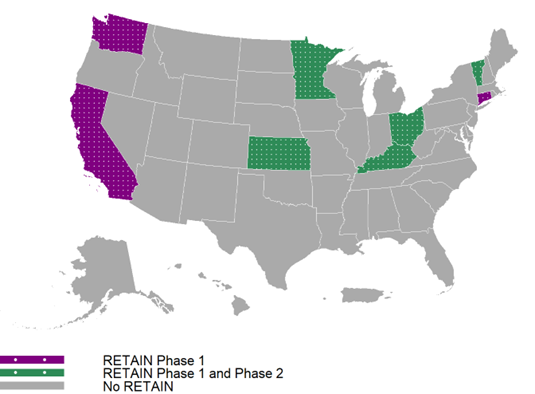
In September 2018, the Department awarded Phase 1 funding to eight states to develop pilot programs:
California, Connecticut, Kansas, Kentucky, Minnesota, Ohio, Vermont, and Washington.
Phase 2: Expansion and Evaluation (2021 - 2026)
Based on Phase 1 performance, Kansas, Kentucky, Minnesota, Ohio, and Vermont were competitively selected to receive Phase 2 funds beginning in April 2021. These states scaled their programs and participated in an independent evaluation led by SSA to test the impact of services on the employment and SSDI outcomes of participants. States received programmatic technical assistance throughout the duration of the grant to support development and implementation.
Funding Overview
| Phase | Funding | Performance period | Grant activities |
|---|---|---|---|
| Phase 1 | $25.7 million total Up to $3.5 million per state | September 2018–March 2021 | Planning, program start-up, pilot implementation |
| Phase 2 | $99.0 million total Up to $21.6 million per state | April 2021–May 2026 | Scaling and implementing RETAIN programs; independent evaluation |
RETAIN Resources
The following resources offer additional information about RETAIN, its participants, and program successes:
RETAIN at a Glance
This brief includes an overview of the RETAIN model, its purpose, and the services that RETAIN programs provided.
Characteristics of RETAIN Participants
These briefs highlight demographic, geographic, health, and employment information on the individuals who enrolled in RETAIN programs. The state-level summaries show unique characteristics of each state’s participant population.
RETAIN Success Stories
These stories illustrate how RETAIN services helped workers overcome injury or illness and return to work. Stories highlight coordinated care, effective partnerships, and the role of RTW coordinators.
RETAIN Success Stories: A Bridge Back to Employment Video
Kansas
Kentucky
Minnesota
Ohio
Vermont