


Frequently Asked Questions
Established by the Chief Evaluation Office (CEO) within the U.S. Department of Labor (DOL), the Clearinghouse for Labor Evaluation and Research (CLEAR) serves as a central source of research and information on labor-related topics. CLEAR identifies areas of interest to practitioners, policymakers, researchers, and the public more broadly; conducts systematic evidence and other types of reviews; and summarizes the studies’ methodologies, findings, and implications for policy, research, and practice.1 Currently, CLEAR houses more than 1,100 study summaries of labor research published between 1978 and the present (date ranges vary by topic area) and continues to expand.
CLEAR identifies and summarizes many types of research, including causal impact, descriptive, and implementation studies.
Causal impact studies include research studies intended to assess the effectiveness or impact of an intervention. CLEAR includes causal impact studies with the following study designs: randomized controlled trials (RCTs), interrupted time series (ITS), and quasi-experimental designs (QED). For causal impact studies, CLEAR provides a quality rating of “low,” “moderate,” or “high” based on an independent assessment of the degree to which the research establishes the impact of the intervention on the outcomes of interest.
Descriptive studies use qualitative or quantitative research methods, but do not attempt to assess the causal impact of an intervention. CLEAR reviews descriptive studies according to guidelines to promote quality and consistency in reviews.
Implementation studies examine the development and operation of an intervention, assess whether implementation went as planned, and explain how the program delivered the planned intervention. Findings from implementation studies provide insights for interpreting the results of impact evaluations and informing generalizability for program replication. CLEAR reviews studies that describe the implementation process of an intervention, or that measure implementation inputs and outputs to assess the fidelity of a program’s planned implementation.
The CLEAR website offers multiple ways for users to access information:
Browse by Topic. CLEAR is organized by topic area, each with its own devoted page, accessible using the topic area navigation bar at the top of each page. Topic pages show available synthesis reports and list individual study profiles included in CLEAR’s systematic literature search. Users can also click on the “Export Results” icon to download the full list of studies to a .CSV file in Excel, for further filtering, sorting, and manipulation.
Search for Studies. The Search for Studies page enables users to search across CLEAR’s full database, using keyword search and filter tools to find individual study profiles of interest. Users can filter search results based on a keyword, publication year, study outcome, target population, firm characteristics (industry, size), geographic setting, study type, and/or evidence rating. Users can also click on the “Export Results” icon to download your search results to a .CSV file in Excel. Additionally, located on the top right of all CLEAR pages, the Search the Site feature allows users to type in keywords to search all content on the CLEAR site, including studies, syntheses, procedures, and other CLEAR documents.
New and Trending Research. The New and Trending Research page includes reports from rapid evidence reviews, flash reviews of single studies, and summaries from CLEAR’s systematic annual search and review (SASR).
Reemployment Services and Eligibility Assessments (RESEA) Topic Area Tab. The RESEA program is a grant program for states to assist individuals receiving unemployment insurance (UI) benefits. On this page, users can find all the studies in the RESEA evidence base, and access current RESEA intervention ratings for each RESEA intervention category.
CLEAR’s systematic evidence reviews are conducted around specific topics or date ranges, and capture all eligible research that examines that topic or that falls in that date range. These reviews are guided by a protocol that lays out a comprehensive literature search strategy and defines criteria for studies to be eligible for review. Systematic evidence reviews may consider different types of research, including causal impact, implementation, and descriptive studies. The following flow chart demonstrates the process by which studies are reviewed for inclusion in CLEAR.
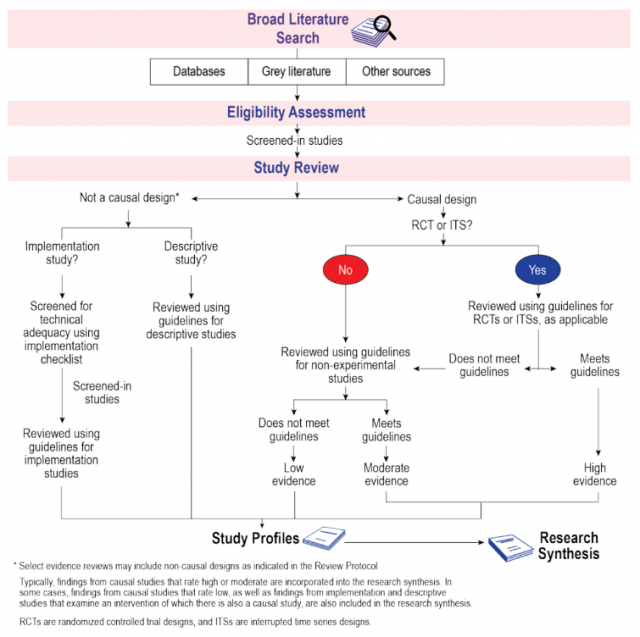
CLEAR describes studies in the following ways:
Study Profiles. For all reviewed studies, CLEAR provides citations and links to the original publication(s), adds highlights of the study, and summarizes a study’s purpose, context, methods, findings, and implications in short, plain language. For causal impact studies, CLEAR provides ratings of causal evidence which are an indication of the credibility of the study’s design and confidence in the study’s findings. For more information on how CLEAR rates causal impact studies, see CLEAR’s Causal Evidence Guidelines. CLEAR’s searchable database includes profiles for all studies reviewed by CLEAR.
Effectiveness icons. Effectiveness icons are included on each study profile page to indicate if the examined outcomes have received favorable, mixed, unfavorable, or no impacts.
Intervention effectiveness ratings. For Reemployment Services and Eligibility Assessments (RESEA), under the Reemployment topic area, CLEAR provides ratings of an intervention’s effectiveness which are an indication of how many credible studies show positive impacts of the intervention within a determined timeframe.
Synthesis briefs. CLEAR also develops short, plain language briefs that summarize the state of the evidence on a given topic area, including what we know about the evidence base and evidence gaps to guide future inquiry.
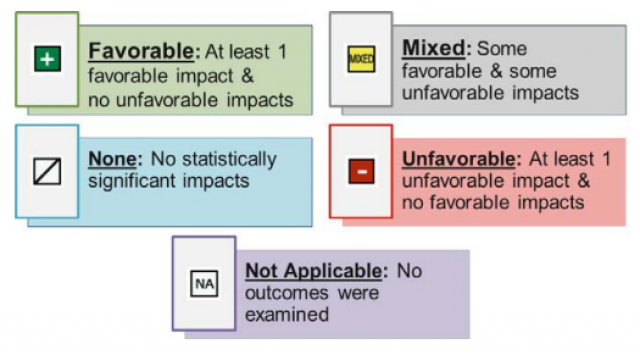
CLEAR assigns causal impact studies a rating of “high,” “moderate,” or “low,” which indicates the strength of the evidence. CLEAR uses its Causal Evidence Guidelines to provide an objective assessment and rating of the degree to which the research established the causal impact of the intervention. CLEAR assesses the quality of evidence for:
Randomized controlled trials (RCTs)
Interrupted time series (ITS) designs
Comparison group designs
Other nonexperimental causal designs (e.g., difference-in-differences).
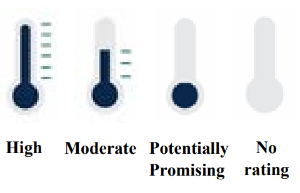
CLEAR ratings describe the strength of the methods used in the study’s design. The ratings indicate how confident we are that the study’s findings reflect the impact of the intervention studied. The following ratings are used to assess a study:
High: Strong evidence the effects are caused by the examined intervention. This means we are confident that the estimated effects are solely attributable to the intervention, and not to other factors.
Moderate: Evidence that the effects are caused to some degree by the examined intervention. This means we are somewhat confident that the estimated effects are attributable to the intervention, but other factors might also have contributed.
Low: Little evidence that the effects are caused by the examined intervention. This means we are not confident that the estimated effects are attributable to the intervention; other factors are likely to have contributed.
For more details on CLEAR’s causal evidence ratings, see the Causal Evidence Guidelines.
CLEAR provides causal evidence ratings for interventions in one topic area, Reemployment Services and Eligibility Assessment (RESEA). These RESEA intervention effectiveness ratings are based on findings from studies that have been reviewed under CLEAR’s “Reemployment” topic area systematic evidence review. During a review, each study is given a causal evidence rating (high, moderate, or low) based on the study’s design. Then, the causal evidence is also reviewed at the intervention level—looking across all studies of a type of intervention or intervention component, indicating the extent to which the evidence available received favorable findings.
For more details on CLEAR’s intervention effectiveness ratings, see the Guidelines for Rating RESEA Intervention Effectiveness.
CLEAR documents causal impact study ratings using a study review guide, following the rigorous process described in the CLEAR Causal Evidence Guidelines. If you have questions on why a study received a particular rating, please contact CLEAR.
Study profiles summarize individual studies, and generally include the following information:
The title of the study.
A citation and link to the original publication(s).
A link to the guidelines used in reviews for the topic area (search bar).
A snapshot of the study’s findings on the outcomes examined.
For causal impact studies, the study’s causal evidence rating (the level of confidence CLEAR has in a study’s ability to estimate causal impacts).
A summary of the study, which includes highlights of the study, details on the intervention or program under study, study findings, considerations for interpreting the study’s findings, and details on the study quality rating.
CLEAR’s study profiles reflect this information from the original publication(s). Profiles make the information more accessible, but CLEAR does not conduct assessments of what was reported beyond what the publications describe.
Flash Reviews. CLEAR’s flash reviews are quick turnaround reviews of studies that fall within CLEAR’s eligibility criteria of an existing or related topic area protocol. They assess research using the same CLEAR procedures and guidelines applied in systematic evidence reviews. Users can nominate a study for a flash review by contacting CLEAR. CLEAR will conduct flash reviews as nominations are received, subject to resource availability. If nominations exceed resources, CLEAR will prioritize conducting flash reviews of research that (1) was nominated by DOL staff who require the review to support decision making, and (2) has gained significant public attention.
Rapid Reviews. CLEAR’s rapid reviews are streamlined reviews that summarize existing and emerging evidence on pressing or trending labor topics, such as the COVID-19 pandemic. Rapid reviews prioritize causal research but can include a broader spectrum of content than systematic evidence reviews, such as white papers by subject matter experts in the field. Due to the rapid nature of these reviews, studies identified for review are not assessed according to CLEAR’s causal evidence guidelines. Instead, CLEAR reviews them using a streamlined rubric to systematically summarize information to meet a more stringent time requirement.
CLEAR’s website is updated with new study summaries and synthesis reports across topic areas on an ongoing basis, as evidence reviews are completed. Evidence reviews that are driven by a topic area are updated periodically, with the date last updated in the status notes of any topic area review. Additionally, beginning in 2021, CLEAR began its systematic annual search and review (SASR), which systematically finds the most up-to-date literature on topics of interest to CLEAR audiences within a certain date range, regardless evidence base size, and across all topics of interest to CLEAR users. Eligible studies will appear in the topic area lists, in CLEAR’s searchable database, and by year on the website.
If you are interested in submitting your research, please contact the CLEAR team with your contact information and the study’s citation. As appropriate, CLEAR conducts flash reviews and other types of evidence reviews as priorities arise and as resources allow.
CLEAR’s plain language study profiles, searchable database, and topic area syntheses are designed to provide accessible information on evidence-based studies related to labor topics. Common ways to use CLEAR include:
Practitioners can find evidence about “what works” to improve their programs or replicate a promising program, develop or fund a new program, or seek strategies to better serve target populations.
Policymakers can access evidence to inform policy directions in labor-related areas, help respond to legislative inquiries, support budget priorities, or meet reporting requirements.
Researchers can learn more about available research in a topic area, identify gaps in the literature and where future research is needed, and obtain information on how to design and implement different types of high-quality studies.
The Chief Evaluation Office within the U.S. Department of Labor established the Clearinghouse for Labor Evaluation and Research (CLEAR) in 2012 to increase the accessibility of research on a wide range of labor-related topics. With more than 20 evidence reviews conducted to-date across labor topics, CLEAR is a central source for labor-related research and evaluation evidence on a variety of interventions spanning employment and training, health and safety, worker benefits, employer compliance, and other topic areas. The Office of Planning, Research, and Evaluation (OPRE) in the Administration for Children and Families within the U.S. Department of Health and Human Services established the Pathways to Work Evidence Clearinghouse (Pathways) in 2020 in response to a Congressional mandate to identify supported interventions for increasing economic self-sufficiency and employment outcomes, and reducing employment challenges for public benefit recipients and low-income populations. Though the two Clearinghouses intersect with part of their target audiences, CLEAR covers labor-related topics more broadly, while Pathways has a focus on research related to self-sufficiency for low-income workers.
Understand How CLEAR Works
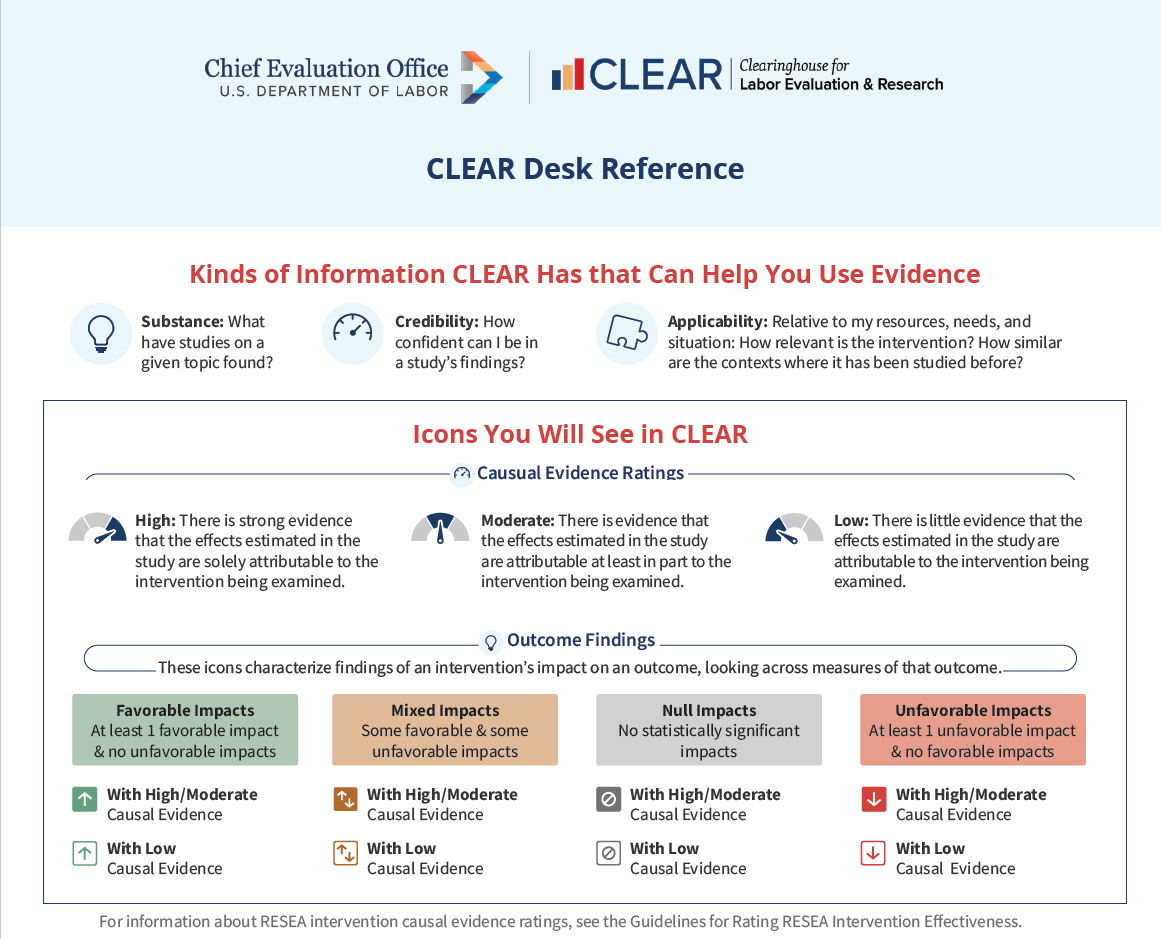
This guide will help you understand our study ratings, resource types, and how to navigate CLEAR.
CLEAR in Action
In Los Angeles:
The LA Mayor’s Office used CLEAR to better support job seekers. Learn how they used CLEAR to inform decision-making.
In Iowa:
See how the state of Iowa used CLEAR to enhance their Reemployment Services and Eligibility Assessment (RESEA) program.
In Texas:
Learn how the Texas Workforce Commission has used CLEAR to develop an evidence-based approach to grant making.